B2B lead generation
How to Get Digital Marketing Clients: Choose Work You Can Demonstrate
· Updated

We recommend making the work visible before making the promise bigger. A prospective digital-marketing client should be able to understand the task, the decisions you make and the inputs you need. “We grow businesses” does not tell them enough to assess a working relationship.
When starting without a case library, build an honest demonstration and a bounded first engagement. That is a useful way to show competence without borrowing another agency’s results. After real delivery, preserve the evidence that explains what happened and what remains uncertain.
Choose a task a buyer can recognize
We would begin with a service that has a clear output. For an illustrative interview-repurposing package, take approved source material through transcription checks, article structure, draft, factual review and handoff. The buyer can then assess the output and the coordination work, rather than buy a vague commitment to “do content.”
Prepare a sample using material you have permission to use. Show an original passage, the edited version and why you changed it. Check names, quoted claims and the relationship between the recording and the draft. Label the work as a demonstration, not a customer engagement.
The first-customer guide can help turn that sample into a relevant conversation. The useful question is who has this work to do and what prevents them from doing it now. A business that needs distribution strategy may not need the writing package you prepared.
Review who does the work in each service format
The original article distinguishes done-for-you, collaborative and self-directed offers. We recommend explaining that distinction through responsibilities: who supplies the source, who produces the output, who checks it and who implements it. None of those formats is automatically the right place for every beginner.
For the illustrative article package, writing from an approved recording is different from sourcing guests, coordinating interviews and publishing the finished work. Consider selling the part you can support reliably, then showing exactly what remains with the client.
The productized-service guide can help define those inputs, outputs and revision boundaries. More tasks can justify a different scope, but they also create dependencies and management work. A useful package removes a defined burden instead of promising that the buyer will have nothing left to do.
Check what a performance number actually measures
We suggest tracing an outcome through the relevant steps: published work, visits, inquiries, suitable conversations, agreements and collection. A reply is not a customer, and a signed agreement is not the same as completed delivery or collected revenue.
For financial claims, review what is included. Revenue compared with advertising spend leaves out other costs and does not by itself establish business profit. A case explanation should retain the actual metric and period rather than turn whichever number looks strongest into a return claim.
The useful reporting habit is to preserve the baseline, the work completed and other changes that may affect the result. If pricing, sales handling or another campaign changed at the same time, record that. Do not make attribution look more certain than the evidence allows.
Choose discovery that helps you define the engagement
Ask what the buyer would consider useful, what they have already tried and who would act on the output. We recommend checking the proposed work against those answers before preparing a pitch. It is acceptable to discover that a different service or no engagement is appropriate.
Read Kyle’s recruitment-agency account for the comparison between a buyer who already knows the brand and a colder sales conversation. His VSL discussion is useful related reading when deciding what context a prospect needs before a call. It is not a measured promise that a presentation will improve your conversion rate.
If a performance-linked proposal is being discussed, check the event that triggers the fee and the records needed to establish it. A delivery project, an appointment and collected sales require different definitions. Lack of case studies is not a reason to accept an event you cannot measure or control.
Review the role of a free sample or service-based resource
A useful sample should reveal competence without becoming an unpaid version of the whole engagement. For the interview package, an explained passage edit may be enough to show the approach. Set the boundary before doing the work and do not make positive praise a condition of receiving it.
Choose content around actual buying questions: what source material is needed, how factual review works or what the handoff includes. This creates a library of practical explanations rather than a collection of broad promises. Reuse a piece where it answers a question, not simply to increase exposure.
For direct contact or paid distribution, review the audience, next action and response capacity alongside the offer. A free resource has production costs, and a low-priced product can create support work. Neither should be described as an automatic route to a higher-priced client.
Choose case evidence after real delivery
We recommend capturing the engagement as it happens: brief, source material, decisions, approvals, output and known outcomes. Ask permission before publication. A useful case explains a real piece of work with its limitations, even when there is no dramatic revenue figure.
Write the case title around what the evidence supports. An explained workflow change or a defined delivery challenge can teach more than an unsupported financial headline. Check that a client’s own statement remains attributed rather than silently becoming an audited fact.
When shortening the case for a proposal, check the metric, period and limits. Another operator’s account can be related reading, but your own claim of delivery needs your own evidence. That distinction helps the buyer assess the service without a promise that the next engagement will repeat the result.
Review the retained historical promotion separately
The original article included an offer promotion. The retained image is historical promotional material, not a statement of the current refund terms or evidence of results a reader can expect. Check the current program’s applicable terms separately.
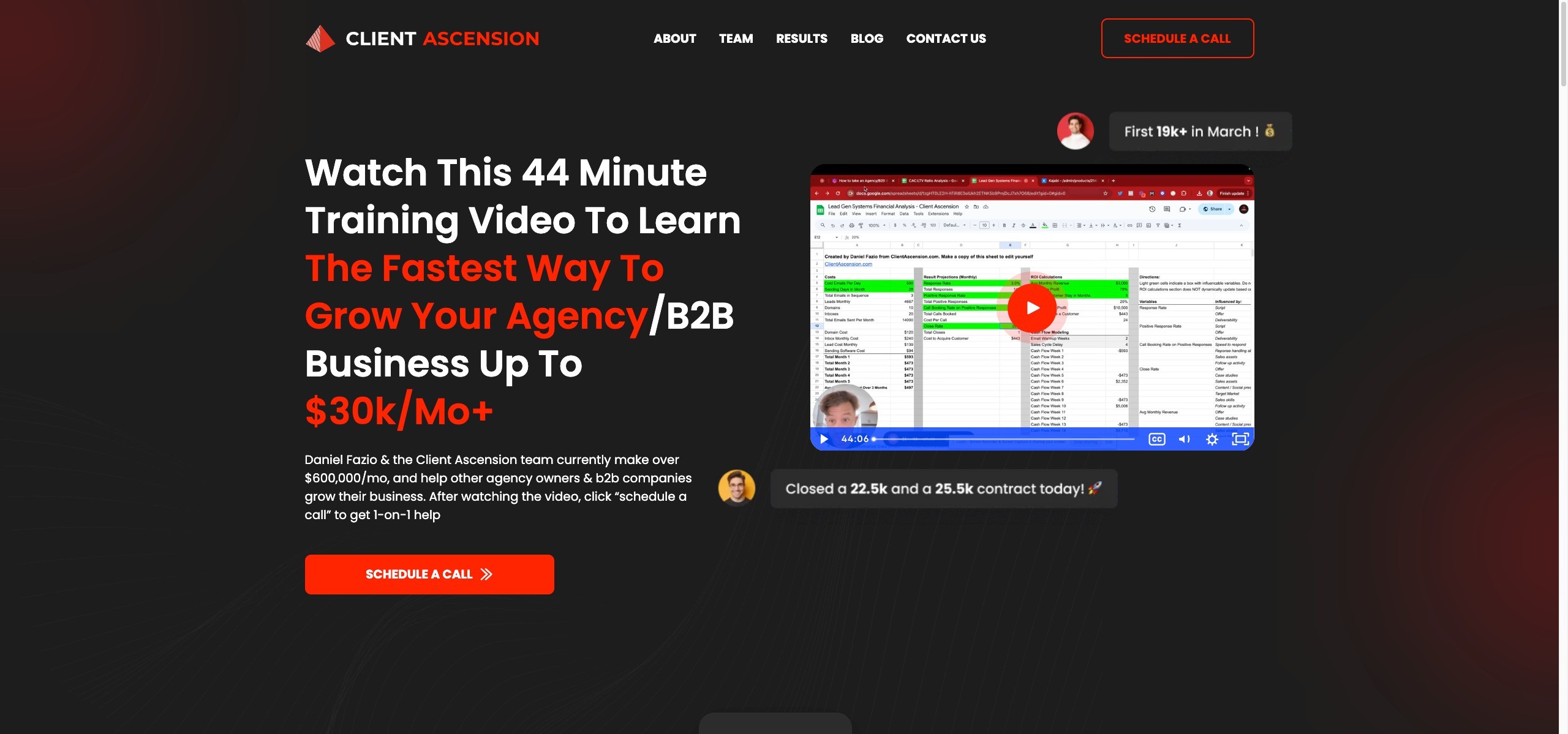
Client Ascension’s current AI Assisted Agency page describes a training and coaching program and lists templates and live coaching. Those are stated program inclusions, not evidence of the customer count or personal income a reader will achieve.
Related service-positioning case studies: Erwin: content and funnel services; Ayman: expanding a video-editing service; Kyle: changing from real-estate ads to writing; Andrej: moving from e-commerce freelancing to an agency.
Prepared by Client Ascension with AI assistance. Documentation checked 2026-10-29.