Agency Growth
How I Diagnose an Agency’s Demand and Pricing Bottleneck
· Updated
When an agency feels stuck, I look at the number of suitable businesses that want to hire it relative to the work it can handle. A better offer, stronger evidence and sales skill still matter, but it is difficult to hold a price when losing the only prospect feels permanent. I would diagnose the pipeline before assuming the solution is simply to charge more.
Find out whether the current pipeline is replaceable
An agency that depends on referrals or occasional platform work may have clients without controlling how the next client arrives. If an account leaves, there is no dependable process to fill the gap.
That situation can create a loop: accept work at a low fee, spend the day delivering it, and have no time left to build acquisition. I want to identify that operating loop rather than describe it only as a confidence problem.
Do not ask the same low-budget buyers to solve the problem
In the lesson, I discuss an automation agency whose existing customers were comfortable with ongoing maintenance but could not readily afford complex additional projects. The owner wanted to quote more for the extra work and worried about offending the people already paying him.
My answer was not merely to say a higher number with more conviction. The business needed exposure to buyers capable of purchasing the larger project. Improving the pipeline changes the available options in a way that an isolated price increase cannot.
Keep standards while increasing qualified opportunities
I also describe an operator with decent conversion on suitable prospects but too few such conversations. Lowering the standard and accepting people the service should not help was not the solution I recommended.
I would increase the absolute number of appropriate opportunities. That may mean better or more content, outbound contact, or an additional acquisition channel. The objective is more good-fit conversations, not a larger total that includes people the agency cannot serve.
Client Ascension related reading: the guide to qualifying agency clients examines the application and buyer-fit side of this problem.
Match the channel to the resources available
I compare outbound, content and ads by time, cash requirement and control. Outbound lets an operator actively start conversations; content can build an audience but depends partly on distribution and skill; ads require cash before the full sales cycle has played out.
For an operator with little pipeline and limited capital, I favor beginning with outbound. I would not use that recommendation as a claim that a message must produce an immediate result or that one channel scales in an exactly predictable way.
With ads, I want to account for the delay between spending and closing. Looking at cost per customer before later prospects have had time to buy can give an incomplete picture of the campaign's economics.
Raise prices when actual options support the test
The situation changes when demand approaches or exceeds available delivery capacity. If there are more suitable buyers than the business can take on at its current fee, testing a higher price becomes a different decision from hoping the only prospect accepts it.
I recommend incremental tests and tracking what happens to qualified calls and closes. The evidence matters more than deciding from a feeling that the price is too low. Social proof and the buyer's willingness to pay still affect the result.
Client Ascension related reading: the service pricing guide works through the relationship between fees, workload and the business model.
Use the bottleneck to choose the next action
If all new work is accidental or referral-based, build a deliberate acquisition process. If that process exists but produces too few suitable conversations, examine volume and add another route where appropriate. If the channel has plateaued, another source of demand may be more useful than repeatedly changing the script.
If demand is already strong but the business cannot take on more work, the problem moves to capacity. I describe expanding the team or keeping the business smaller with a higher margin as different options; growth does not require every owner to choose the same structure.
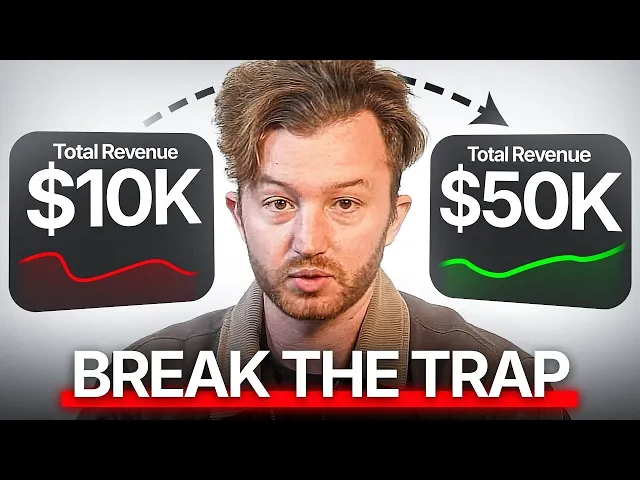
I would keep the diagnosis specific to the agency. The lesson's revenue stages and channel figures are explanatory examples, not universal thresholds that determine when every business should hire, advertise or increase prices.
Adapted by Client Ascension with AI assistance from Daniel Fazio's lesson. The first-person narrative follows the source speaker’s account. Watch the original video