Marketing & Sales
Inside My Meta Ads Funnel: Opt-Ins, Applications and Sales Follow-Up
· Updated
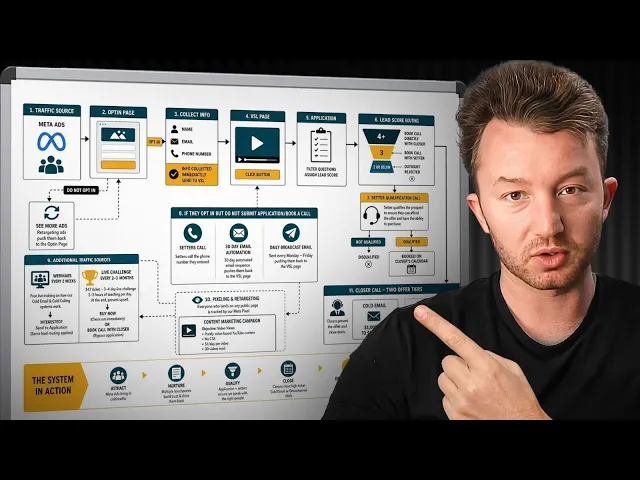
The funnel I walk through starts with a Meta ad, but it does not end with an opt-in or a booked call. It connects the landing pages, application, sales team and follow-up so that people have more than a single opportunity to move forward.
I reported making $13.6 million from $3 million in ad spend with this funnel. That source-reported amount is not profit or a verified return on investment; the lesson does not establish a complete cost breakdown or reporting period. The useful part here is the structure and how its stages connect, not a promise that copying it will reproduce the result.
Why I use an opt-in before the sales video
My preference in this funnel is an opt-in page that collects a name, email address and phone number, followed by a video sales letter. The reason I give is that we do substantial calling and emailing after someone enters the funnel.
An opt-in only makes sense in that explanation because there is follow-up behind it. I am not presenting the page alone as proof of a higher conversion rate, or treating the contact details as a purchase.
Use the application to route the next conversation
Under the video, I place a button opening a Typeform application. Answers receive a lead score, and the score determines whether a person can book with a closer, needs a setter conversation first or is rejected.
My historical setup let scores of four or above book directly with a closer, routed a score of three to a setter and rejected scores of two or below. I explicitly say the scoring system is something you design for your offer; those thresholds are not a universal qualification model.
Give setters a qualification job
For the setter route, I describe checking whether the prospect can afford and purchase the offer. In this cold email business, that also includes whether the prospect's addressable market is large enough for the service.
If the prospect is qualified, the setter books them onto the closer's calendar. If not, the setter disqualifies them. I see that conversation as performing a qualification role similar to the application, rather than making a setter booking equivalent to a sale.
Follow up when an opt-in does not become an application
If someone opts in but does not apply or book, I describe setters calling the submitted phone number and email follow-up. The historical email setup combined a 30-day automated sequence with broadcast emails from Monday through Friday; people in the sequence were not excluded from broadcasts.
That describes the operating setup at the time. The lesson does not provide an experiment isolating the effect of the sequence, broadcast frequency or setter calls, so I would not attribute the reported result to any single touchpoint.
Client Ascension related reading: the marketing volume and follow-up article explains the broader argument for keeping interested prospects in a pipeline.
Distinguish content remarketing from a direct sales ad
I also describe showing video content to people who had reached our public pages. We uploaded YouTube videos to Meta and used a video-views campaign objective to get that audience watching more of our content, rather than attaching a direct sales CTA to each video.
For this setup, I described 30 videos at $1 a day per video, or $30 a day altogether. That was a historical budget example, not a current recommended minimum or evidence that every prospect will buy after seeing the videos.
Use the existing audience for training events
Beyond the initial ads funnel, I describe webinars and live challenges promoted to the audience that had already opted in. At the end, people could move toward a sales conversation, and the challenge could also offer a self-checkout route.
These routes bypassed the ordinary application in the setup I described because the training had already done part of the selling. They were additional paths for an existing audience, rather than a claim that the same event was being advertised directly to cold traffic.
Client Ascension related reading: the channel stacking lesson covers how offers and conversion mechanisms can connect once product-market fit exists.
The diagram is only part of the implementation
I end by pointing to the work underneath the diagram: the cold-traffic offer, ad creative, sales scripts, automations, closers and fulfillment. Knowing which box follows another does not answer those implementation questions.
The workshop dates, ticket prices and other promotions in the source are historical. I would use the funnel as an operating example rather than reading those event details as a current invitation.
Client Ascension related reading: the AI Assisted Agency program page supplies current program information, separately from the historical workshop described here.
Adapted by Client Ascension with AI assistance from Daniel Fazio's lesson. The first-person narrative follows the source speaker’s account. Watch the original video