Sales & Business Growth
How I Think About Selling Higher-Value Agency Deals
· Updated
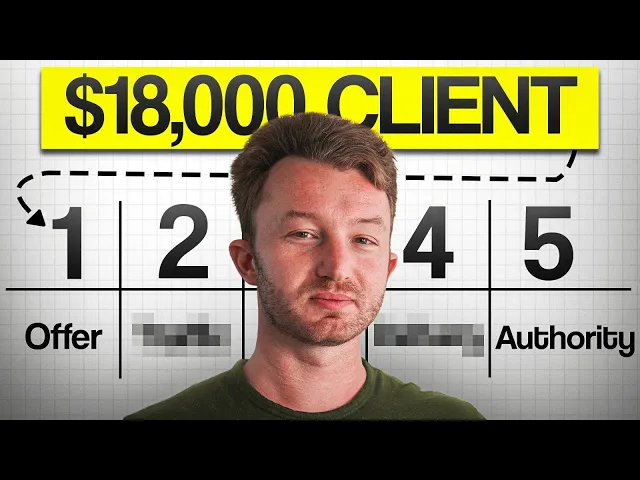
I look at five connected components when discussing higher-value deals: the offer, traffic, sales, fulfillment and authority. The product has to be worth the fee, but a weak component around it can still prevent the sale.
The examples I opened with included an $18,000 quarterly deal, two $6,000 monthly deals and a $3,500 quarterly deal. Those were historical deals I described in the lesson. They are not current prices or a promise that someone else can charge the same.
Make the result and the work clear
For cold traffic, I want the buyer to understand what new result the service creates and how much work it takes off their plate. I contrasted that with an optimization pitch that a prospect may perceive as taking credit for something they already had.
The distinction is about how the buyer sees the exchange. I used an informal CRM discussion to explain why some owners did not want a revenue-share reactivation offer. That conversation supports my reasoning about the pitch; it does not prove that every optimization service fails in every market.
Look at risk and commitment together
I use a guarantee or performance-based arrangement to reduce the buyer's risk. Commitment matters too: a one-time payment, a smaller initial price or an agreed exit gives the buyer less to commit to at the start.
Responsibilities need to be clear when results depend on the client as well as the provider. I talked about setting those expectations in the agreement. That is a discussion of offer design, not a statement that every refund request can be decided by one blanket rule.
Client Ascension related reading: Oleg’s outbound agency account discusses a repeatable outbound offer and its pricing.
Keep traffic moving while you build delivery
I group acquisition into outreach, content and ads. I had seen owners stop those activities to catch up on fulfillment, then find themselves rebuilding momentum later. I would treat traffic generation as an operating function rather than something to restart only when the calendar is empty.
I also distinguish warm leads from cold ones. A business that closes a large share of referrals should not assume the same close rate applies to unfamiliar people coming from outreach or ads. The source of the lead changes the context of the sales call.
Show the assumptions behind the sales case
For a higher-value service, I use an ROI calculator to walk through possible booked calls, close rate, client price, acquisition cost and lifetime value. It makes the assumptions visible. A projected return is a scenario, not evidence that the prospect will actually receive that return.
I gave done-for-you cold calling as an example: the buyer wants meetings that can become customers. The calculator connects what they pay with those steps rather than only showing a large headline. I also test responses to recurring objections and keep the talk track that works best, without expecting it to persuade everyone.
Map fulfillment before assuming you cannot delegate
I map delivery like an assembly line, from the first task after signing a client through the work that follows. For each step, I ask whether AI can handle it or whether a person needs to manage it. In a cold email service, list building and the domains are concrete jobs to place in that process.
I described hiring scorecards with compensation, responsibilities and tasks, then customer success managers who handle communication and coordinate delivery specialists. The aim is a system that does not require the owner to personally think through every client task all day.
Give buyers a reason to believe you can deliver
Authority can come from relevant experience, demonstrated competence and case studies. I used a hypothetical former Meta employee to illustrate how experience can provide credibility even before someone has their own agency clients.
For an existing service, I would show how the work produces results rather than only claim expertise. In the lesson, I described showing live cold-calling activity and meetings. That is the kind of evidence I want a buyer to be able to inspect, rather than treating a higher price as proof of quality.
Client Ascension related reading: the paid funnel guide discusses historical lead qualification and application flows.
Adapted by Client Ascension with AI assistance from Daniel Fazio's lesson. The first-person narrative follows the source speaker’s account. Watch the original video