Agency Growth
How I Diagnose an Agency Bottleneck Before Changing the Offer
· Updated
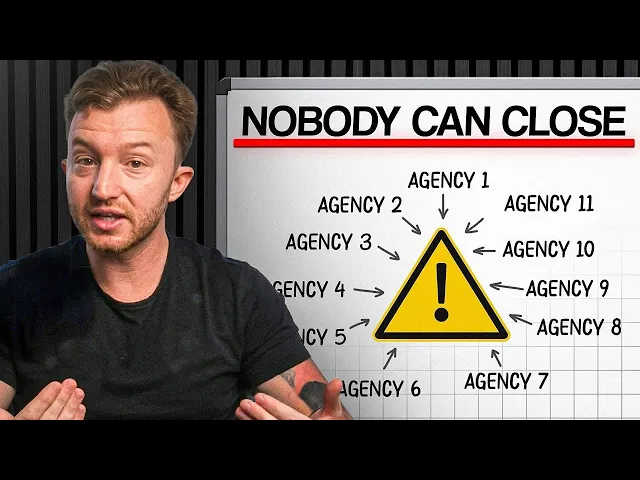
On a coaching call, I heard agency owners asking for more leads, a different niche or a new mechanism when I thought something else was holding them back. I grouped those discussions into recurring mistakes. The useful question was not which new tactic to add, but which part of the business needed attention first.
My rule was to identify the specific problem, make a focused change and wait to see what it does. If you rewrite the offer, change the audience and introduce another acquisition channel together, you lose the ability to tell which change mattered.
Separate booking, closing, pricing, fulfillment and targeting
I separate not getting calls from not closing the calls you already get. I also look at whether the pricing or offer structure creates friction, whether clients stay after the sale and whether the service is being offered to the right people. Those distinctions give me a place to investigate instead of treating every disappointing result as an offer problem.
The mistake I kept seeing was misattribution: an owner would choose a solution for a problem they did not actually have. I wanted them to describe the stage that was failing before spending more money or rebuilding the business around a new idea.
Look at the commitment before buying more calls
One owner was already booking qualified sales conversations through cold email and wanted to start running ads. When we examined the proposed purchase, the prospect had to commit to three months of ad spend plus the agency fee. The combined commitment was $15,000, presented to businesses with five to ten employees.
I suggested a one-month test with $3,000 in ad spend and a $2,000 management fee, followed by a longer engagement if the results justified it. That proposed entry commitment was $5,000 instead of $15,000. It was an offer test to consider, not a measured improvement in the owner’s close rate.
I also wanted him to improve the sales work. If the message is producing calls, changing that message or adding a channel can distract from what happens once a prospect arrives. My diagnosis in this case was to inspect the entry risk and the sales conversations before purchasing more lead flow.
Put the actual offer in the outreach
Another owner said the niche was wrong because nobody was responding. I asked to see the email. His service was performance-based cold email lead generation, but the message did not actually explain that service or the payment condition. The prospect had not been given a clear proposition to evaluate.
The rewrite I proposed said what the service was and that the client would pay per call that showed up. That is a different argument from asking whether someone wants to grow their company. Before testing a new industry or increasing volume, I wanted the current message to convey what the owner was offering.
Client Ascension related reading: the offer formulation guide examines the problem, mechanism, pricing and risk allocation behind a service proposition. Review it when the offer itself still needs to be explained clearly.
Inspect fee friction before adding a new mechanism
An agency owner was getting calls but believed he needed an AI feature or a unique mechanism to stand out. I asked to see the full pricing: a $1,000 setup fee, a $500 monthly technology fee and $250 per booked call. In that discussion, I focused on the way the charges were presented rather than adding another feature.
My proposed change was to remove the setup fee and use a $1,000 monthly technology fee plus the performance charge. I was trying to simplify the buying decision. The proposal did not establish the owner’s eventual sales result or a fee structure every agency should copy.
The diagnostic point is to find out what happens after someone agrees to talk. I used the fact that calls were being booked as a reason to inspect pricing and sales next, instead of assuming that another technical feature would resolve the objection.
Judge a niche by delivery as well as response
I discussed an owner who chose commercial cleaning companies after using an AI niche finder. I was concerned that interest in lead generation was being treated as enough evidence that the service would be straightforward to deliver. Getting a response and creating useful results for a paying client are different tests.
I wanted the owner to ask both whether prospects would respond and whether the agency could deliver after signing them. My comments about particular industries were part of that coaching discussion; the broader decision was to examine the buyer’s economics and the effort required to serve them, rather than judge the niche from reply rates alone.
Client Ascension related reading: the client fulfillment guide maps information gathering, production, quality checks and communication. It offers a separate process to examine when delivery is the constraint.
Explain the payment condition instead of decorating it
I saw a performance-based lead-generation proposition being presented with a meeting target, a deadline and a refund promise layered on top. I wanted the owner to lead with the central condition: the client pays for qualified meetings that show up. That condition was the offer I was trying to communicate.
My objection was to adding complexity in the name of differentiation when the payment condition already gave the prospect something concrete to assess. The lesson was about how to state that particular proposition, not evidence that a performance arrangement removes delivery risk or suits every service.
Decide whether strangers can understand the service
An owner had a DevOps automation service with clients, but cold email was not selling it. He wondered whether he should replace the business with a cold email agency. I did not think changing the entire model was the only path. I considered how much explanation a new prospect needed before understanding the value.
The options I discussed were to reposition the work around a clear business outcome for cold prospects, or to build an audience through tutorials and other useful content. The pipeline-system pitch I gave was an example to test. It was not a delivered campaign or proof that the proposed output had already been achieved.
If that repositioning did not work, I wanted him to consider building people’s familiarity with the service before asking them to buy. That keeps the question on the route to an appropriate buyer, rather than assuming an existing service must be discarded because one outreach approach is not converting.
Make a focused change and reassess the next bottleneck
My decision tree works backward through the business: look at capacity and systems, whether clients stay, whether calls close and whether calls are being booked. If clients leave after buying, investigate fulfillment and fit. If calls happen but purchases do not, inspect sales and offer structure. If calls are absent, examine the front end.
Once I identify the constraint, I want to change that part and reevaluate it. I do not want an owner to solve a booking problem they do not have, or keep signing more clients into a delivery problem. The sequence is to diagnose, change, observe and then decide where attention belongs next.
Adapted by Client Ascension with AI assistance from Daniel Fazio's lesson. The first-person narrative follows the source speaker’s account. Watch the original video